


Knowledge Center
December 2, 2025
How to Use Ultrasonic Indicators in Medical Device Processing
How to know if your ultrasonic cleaner is working properly

In healthcare, ensuring that surgical instruments are thoroughly cleaned before sterilization is not just best practice; it's a critical safeguard for patient safety. If a device is not cleaned properly, it can't be sterilized properly. As surgical procedures become more complex and the surgical instruments more intricate, Sterile Processing Departments (SPDs) are under increasing pressure to deliver consistent, high-quality results. One technology that plays a pivotal role in this process is ultrasonic cleaning.
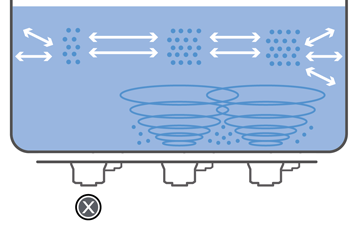
Ultrasonic cleaning is a method that uses high-frequency sound waves transmitted through a solution to create microscopic bubbles. These bubbles rapidly form and collapse in a process called cavitation, which produces tiny vacuum forces that dislodge contaminants from hard-to-reach surfaces like hinges, lumens, and serrations.
Learn more about Ultrasonic Cleaning in our Article:
“Guide to Ultrasonic Cleaning of Medical Devices: How Ultrasonics Work and More”
The Four Critical Parameters of Effective Ultrasonic Cleaning
To be effective, ultrasonic cleaning depends on the precise interaction of four critical parameters:

Time
Each instrument has specific instructions for how it should be cleaned. Using a one-size-fits-all cycle can leave residual soil or damage devices. Over- or under-cleaning can compromise both the instrument and patient safety.
Temperature
Many enzymatic cleaning solutions require a specific temperature range to function properly. If the ultrasonic cleaner cannot maintain this temperature, the enzymatic activity may be reduced, leading to incomplete cleaning.
Chemistry
The cleaning solution must be low-foaming and formulated to suspend soils, so they don't redeposit. Prolystica™ HP Instrument Cleaning Chemistries are formulated and optimized for ultrasonic cleaning, and sequestrants prevent soil redeposition.
Cavitation
This is the mechanical action that removes the soil. A failed transducer can create a "dead zone" in the tank, compromising cleaning in that area. Cavitation must be uniform and consistent throughout the tank.
If one of these key parameters fails, device cleaning can be compromised. Hence, it's important to ensure your ultrasonic cleaner is functioning properly and successfully at all four of these parameters. But how do you know your ultrasonic cleaner effectively cleans those devices? That's where ultrasonic indicators come in.
How Ultrasonic Indicators Work

Ultrasonic indicators are tools used to verify that the ultrasonic cleaner is functioning correctly. They help ensure that all four critical parameters (time, temperature, chemistry, and cavitation) are being met.
Proper placement of ultrasonic indicators throughout the tank is essential for zone monitoring, which helps detect transducer failures that might otherwise go unnoticed. A single indicator placed in the center of the tank may not detect issues on the sides or corners, especially in larger units, for example.
Two Common Types of Ultrasonic Indicators
Ultrasonic Indicator Strips: These are often used with holders and can test multiple parameters. They may include synthetic soil to simulate surgical debris and require visual inspection after the cycle.
Ultrasonic Testing Vials: These typically test only for cavitation and use color changes to indicate results. While easy to use, they often lack the ability to test for temperature or chemistry effectiveness.
Testing practices can vary between hospitals. If facilities rely on indicators that only test one or two parameters, this leaves blind spots in the verification process. Others use indicators that rely on color changes, which can be challenging to interpret - especially for colorblind staff. These inconsistencies can lead to delays, retesting, and even the risk of unclean instruments reaching the operating room.
Why is my ultrasonic monitoring process not working?
Let's consider two real-world-inspired scenarios that highlight the importance of comprehensive ultrasonic monitoring.
Scenario 1: The Silent Transducer
A facility processing robotic-assisted surgical instruments begins noticing bioburden on tools that have already passed through cleaning. An audit reveals a transducer failure in the ultrasonic cleaner. Because the facility wasn't using zone monitoring, the issue went undetected, and instruments were processed in a "dead zone" with limited or no cavitation.
Scenario 2: The Invisible Problem
Another facility uses an indicator that only tests for cavitation. When their cleaning chemistry runs out, the indicator still shows a passing result. Instruments are then processed without detergent, compromising patient safety. The facility assumed the cleaner was working properly, but the indicator failed to detect the missing chemistry.
These stories underscore the need for indicators that test all four parameters, not just one or two.
Comparing Ultrasonic Indicators
Basic vial indicators typically test only for cavitation and rely on color changes, which can be subjective. Multi-strip systems may test multiple parameters but often require separate components and interpretation steps. In contrast, the VERIFY™ DualAction Ultrasonic Indicator is an all-in-one product that tests time, temperature, chemistry, and cavitation in a single strip. It uses a synthetic soil patch and a foil strip to provide clear, objective results. A passing result requires both the complete removal of the soil and the breaking of the foil, making it easier for all staff to interpret.

Addressing Common Challenges Faced in the SPD

The VERIFY DualAction Indicator helps solve several issues commonly faced by SPDs:
-
Clarity: No reliance on color changes means fewer misinterpretations. The foil strip and soil patch provide binary, visual cues that are easy to read.
-
Efficiency: Reduces the need for retesting and speeds up instrument turnaround. Staff can quickly verify cleaner performance and move forward with confidence.
-
Cost-Effectiveness: One product replaces multiple indicators, simplifying ordering and inventory. It also reduces the risk of using the wrong indicator for the incorrect parameter.
-
Safety: Uses non-biohazardous materials, making disposal easier and safer. This also allows facilities to retain test records without special handling requirements.
Best Practices for Testing Ultrasonics
To get the most out of ultrasonic cleaning indicators, facilities should:
- Test daily: ANSI/AAMI ST79 recommends testing ultrasonic cleaners every day they are used, after installation, and following major repairs
- For larger tanks, place multiple indicators in different zones to ensure all transducers are functioning - always refer to the equipment operator manual/IFU for the specific indicator and ultrasonic cleaner for placement instructions
- Train staff: Ensure all technicians understand how to use and interpret the indicators. This includes proper placement, reading results, and documenting outcomes
- Document results: Keep records of test results to support quality assurance, compliance, and traceability
Related Resources



Article References
1 ANSI/AAMI ST79:2017, Comprehensive guide to steam sterilization and sterility assurance in health care facilities. AAMI.
2 World Health Organization. Decontamination and reprocessing of medical devices for health-care facilities. https://apps.who.int/iris/handle/10665/364587

| FOLLOW US | |
|---|---|
 20,400 FOLLOWERS
|

|
 8,600 FANS
|

|
 4,000 SUBSCRIBERS
|

|
 2,700 FOLLOWERS
|

|